Showing posts with label library. Show all posts

Sunday, 5 July 2026

30 Years of Not Being Published

A few will be aware I have been known to speak on various subjects over the years. Fundamentally these all revolve around my favourite subject of etymology. Have always enjoyed bringing this fascinating subject to others. It’s not for me to say whether the audiences have, although many have asked me to return.

Thought it might be worthwhile sharing a snippet or two from these etymological presentations, continuing with 30 Years of Not Being Published. In over three decades more than ninety published works have appeared on the shelves. This talk is not as negative as it may first seem. During this period I have amassed a vast number of rejection letters, but still managed to average three books a year and more than one article each and every week. Listen to the experiences, the mistakes, the ideas, the tips and advice on how all writers have something to learn and also to contribute to the literary world. There is a PowerPoint presentation to accompany this talk if required.

When it comes to finding a publisher, possibly the best piece of advice I have is simply to find a published book that is as close to yours as possible, then pitch it to that publisher. The reason? Because an editorial department have the job of producing something new, but sales teams want what is selling .

Interesting verbs are seldom very interesting. — Says Jonathan Franzen, who fails to remember ‘very’ is a word which Oscar Wilde advised writers to edit out and replaced with ‘damned’ as the publisher will then cross out every example and thus make the ideal manuscript.

“Write what you know about” – Brilliant advice. Except for the advice on how to check every fact, research every snippet, and all the rest of the baloney. And there’s also the fact that people (yes even writers) are sometimes mistaken and what they “KNOW” is incorrect. If not, nobody would ever get divorced, have unwanted pregnancies, jobs they can’t do, or ever make a mistake. As a little pointer to how stupid this advice is, do some research into all these HOW TO books for writers and look at how many books they’ve had published previously – you’ll be amazed at how often it is their FIRST and perhaps even ONLY book .

If you think you know someone who would like to hear me speak on this subject, drop me a line.

Sunday, 29 June 2025

Going Underground: Birmingham

Thanks to Robert Deloyde roving around with his camera, I am able to add more to the information contained in the book. I am indebted to Robert for the information.

Near to the corner of Hill St and Station St was a Gentlemen's Toilet, it was just below the roadway, at some point it was closed down and filled in, when New St Station had a refurb, guess what was uncovered?

Robert was surprised I did not mention the Bus/Coach station that was built but never used under Birmingham's former Central Library.


Robert also pointed me in the direction of the service area of the Big Top, (entrance is opposite Moor St Station). This not built with articulated lorry's in mind in the 1950s, with the exit in New St. Never built because of the cost.

Woolworths in New St had it own service area in Stephenson Street. A loading bay had spaces for the managers cars, the area dark and dingy. Possibly you can still see the slope to the loading bay from Stephenson Street next door to two large lifts still visible in Stephenson Street that go down one floor to an underground car park with room for about twenty cars.


When Rackhams was a going concern at the top of the slope there was a turntable so that you could drive onto the turntable and push the van/lorry around so that you could back onto a loading bay, but what used to happen was that van/lorry's would hit the turntable at speed causing it to turn around until the driver would reverse to the loading bay, thereby stopping the rotation. This turntable lifted many years ago when the vehicles grew too big.

In the book I spoke of working in Digbeth and the problems when the River Rea flooded. Just before the Ironmonger's closed for the last time (Gregory Pank's) after trading for some five decades - Robert took a few shots inside the shop, and with their permission I took a few in their cellar. Full of stuff, including boxes, a table and, in one corner, a pump used to empty the cellar when the river flooded it. Previously this had been a baker and also a pub. The only light into the cellar from a number of glass panes in the ceiling.

Tramways still have some rails in situ, never having been raised.

When work started of HS2 in Curzon Street, on removing the concrete and soil, now covered over, this brick work was revealed and Robert wonders if it belonged to the earlier railway buildings.


Sunday, 23 January 2022

Alphabetical order

For the last few weeks, I have posted a number of words which have changed in meaning and/or usage over the years. I do hope you enjoyed some of these and found something interesting.


When preparing those posts, I discovered something which for me was really weird. Alphabetical order, the way I used to post the words and the system of sorting which is common to most lists, has only been used since about 400BCE. How on earth did anything get sorted before then and what changed?

The obvious explanation as to other forms of ordering is down to the lack of an alphabet. There are plenty of other forms of writing which does not use an alphabet - think of cuneiform, hieroglyphs, the many Asian forms of writing - hence alphabetical order is simply not possible before the invention of the alphabet. Furthermore, until those first letters or characters were sorted into an accepted order, no alphabetical base existed and thus no alphabetical order.


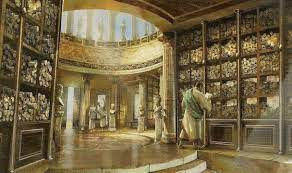
The first evidence of alphabetical order comes from the famed Library of Alexandria around 2,300 years ago. It is reasonably safe to assume this can never have been used unless alphabetical order was already in use - otherwise how would any user of the library have known where to look to find what they were looking for? Even then the use of alphabetical order would have been mostly pointless for most of the next 1,500 plus years, as most libraries and records offices simply did not have enough books and documents to warrant its use.

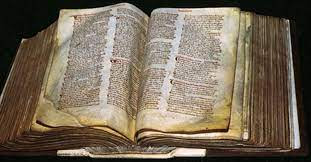
Take the famous Domesday Book, for example. The original is based on a system where they were sorted initially by status and then geography. Luckily later publications have opted to go for counties and then alphabetical order, or it might take many hours sorting through the 13,418 places listed. Two centuries later and religious documents are still being ordered theologically. Hence, 'angel' did not come before 'God', the order more based on status and then order of creation. Even as recently as the early nineteenth century, alphabetical order was seen as tantamount to sorting a broken mirror by just gathering up the pieces. This was how poet Samuel Taylor Coleridge described encyclopaedias, he preferred things sorted by themes.


Before you laugh at the ridiculous ideas of how to sort items in a list or record, keep in mind it is not that long ago - before the days of the internet and the search engine - we often paused in looking up something, to wonder what will it be filed under? Remember looking up something only to find 'Look under ....."?

Tuesday, 29 May 2018

The Castle Inn Fire

On 2nd November 1838.chambermaid Mary Gardner, cook Harriet Bonner, waitress Mary Ann Rooth, barmaid Caroline Smith and kitchen maids Mary Chatterton and Harriet Buswell had all retired to bed by 1:30am on the Friday morning. About two hours later the alarm cry went up when someone called out FIRE! Landlords Mr and Mrs Webb awoke and, on opening the door to the passage, discovered their path was blocked by the smoke and the great heat. On returning to their bedroom they escaped via the rear window, having attracted the attention of those below.


Initially the proprietors were assured the girls were safe. However, it soon became clear they were most likely still inside. A ladder was found and a search discovered the bodies of the girls. Five of the girls had died as a result of asphyxiation, barmaid Caroline Smith discovered at the top of the stairs with her hands and face badly burned. At the inquest a verdict of accidental death was recorded. The cause has never been understood.  


Four days later one of the most elaborate of public funerals ever seen in Tamworth took place. All the shops closed at 4pm as a mark of respect and to allow the funeral procession to come from the Kings Arms to the churchyard of St Editha's. The streets were thronged with mourners and, despite the vast numbers, all was completely silent. All six were buried in a communal grave, later topped by a memorial paid for by public subscription. The massive funeral costs were covered by their employer, Frederick Webb of the Castle Inn. 

In the 1960s the remains were removed and reburied at Wigginton Cemetery. Close to one corner of the church lies a headstone to William Smith and, as inscribed on that headstone, nearby the remains of his daughter, Caroline.