Several words have become part of the language in being used in phrases. Last time we looked at ‘bomb’ and now look at ‘spring’.
Spring has more than one use, the word referring to the metal coil which proves so useful in keeping us comfortable and also in a clockwork mechanism. Both these can be traced back to Germanic words meaning ‘burst, jump, etc’. Yet we also use ‘spring’ to refer to a water source, this can also be traced back to the same origins, and the season we now find ourselves in – at least in the northern hemisphere. This last usage is rather different as it comes from Proto-Indo-European sper meaning ‘to spread, sow’ and therefore taken from the action of sowing before those seeds burst forth into plants; later giving a name to the season when such planting happens. Note the action of spreading or sowing sees the seeds spread more sparsely – and ‘sparse’ also has its origins in the Proto-Indo-European sper.
Spring fever is seen from 1843, a reference to romantic feelings. Prior to that it was used to refer to a head cold, or to any minor ailment.
Spring roll, as in the cuisine, is first seen in 1943.
Spring chicken may be used to mean ‘young person’ today – although usually used in the negative as in ‘no spring chicken’ – but that has only been true since 1906. Before the 20th century, specifically since 1780, it referred to the bird aged 11 to 14 weeks.
Spring training today is used almost exclusively in referring to baseball; but before 1889 the same phrase spoke of the gathering together of military forces after a winter of little action.
Spring tides rise at or shortly after the full moon and are higher than the norm and is seen since 1520. The reference to the season is simply an erroneous ‘springtime’. Prior to 1520 these high tides (not confined to the season) had been known as a ‘spring flood’.
Springtime itself had been used for the season since at least the late 14th century.
Offspring were unknown before 1600. Prior to that we find ‘ofspring’, ‘ospring’, and ‘oxspring’.
Springboard, and this is in the sense of the board used for vaulting, surprisingly comes from as early as 1774. Clearly the metaphorical sense came later.
Springtails are insects using bristles at their rear end to aid in leaping. Known as such since 1797, the species has been around for millions of years and thus not known as such for most of their existence.
Mainspring, as in the primary spring in a mechanism, is first seen in 1590 – although it is not clear whether the clock or the gun was first to use the term.
Springbok, the gazelle synonymous with South Africa, is named from the Afrikaans meaning ‘to leap’ and has been known as such since 1775. Prior to that they were known to the locals as ‘trekbokke’ – amongst others.
Showing posts with label insect. Show all posts
Monday, 29 April 2024
Sunday, 31 October 2021
That was not what I meant. (L)
With the original definition of 'lord' I might not want the title. I only said 'might', note.
Large today is the opposite of 'small', but when it first came to English in the twelfth century it was used more in the sense of 'liberal' or 'generous'.
Larva, that's the young of an insect, is the Latin word for a 'ghost, spectre'.
Ledger today suggests an accounts book, historically it was a book which remained in one place.
Legend may suggest a glorious tale or myth today, but its earliest use was specifically the story of a saint's life.
Lewd today is anything coarse of crude, but when first used in the sixteenth century meant anything but, for the sixteenth century usage would suggest 'lay' in the sense of 'not clerical'
Liaison means 'cooperation, communication', but came to English in the seventeenth century to refer to the thickening of sauces (especially using egg yolks) in cooking.
List is a column of items or notes today, but originally referred to the 'border, strip' on the page.
Literature is surely nothing other than the written word, but in the fourteenth century it was used in a much more general sense to mean 'learning, knowledge'.
Litter has two meanings today - multiple births for an animal, or rubbish - but historically it came from Old French and meant 'bed'.
Loaf today refers to the whole baked lump of bread, but historically was used as a synonym for 'bread'.
Loan has to be given back today, it's what the word means. But before the fifteenth century it referred to a gift, particularly one from a person of superior standing or a gift seen as coming from God.
Locket may be a small container worn as an item of jewellery today, but when it first came to English it referred to an iron bar across a window - designed, quite literally, to 'lock it'.
Lollipop is specifically a sweet on a stick, but before the eighteenth century it referred to any sweets.
Lord, as in the rank and not the deity, may be a member of the nobility today, but when first used in English described a hlafweard which literally means 'loaf ward' or 'keeper of the bread'.
Lot, as in a large amount or many, came to English meaning 'portion' as is still used in words such as 'allotted'.
Lucid is a synonym of 'clear, plain', but when it came to English from French in th sixteenth century, it meant 'shining'.
Large today is the opposite of 'small', but when it first came to English in the twelfth century it was used more in the sense of 'liberal' or 'generous'.
Larva, that's the young of an insect, is the Latin word for a 'ghost, spectre'.
Ledger today suggests an accounts book, historically it was a book which remained in one place.
Legend may suggest a glorious tale or myth today, but its earliest use was specifically the story of a saint's life.
Lewd today is anything coarse of crude, but when first used in the sixteenth century meant anything but, for the sixteenth century usage would suggest 'lay' in the sense of 'not clerical'
Liaison means 'cooperation, communication', but came to English in the seventeenth century to refer to the thickening of sauces (especially using egg yolks) in cooking.
List is a column of items or notes today, but originally referred to the 'border, strip' on the page.
Literature is surely nothing other than the written word, but in the fourteenth century it was used in a much more general sense to mean 'learning, knowledge'.
Litter has two meanings today - multiple births for an animal, or rubbish - but historically it came from Old French and meant 'bed'.
Loaf today refers to the whole baked lump of bread, but historically was used as a synonym for 'bread'.
Loan has to be given back today, it's what the word means. But before the fifteenth century it referred to a gift, particularly one from a person of superior standing or a gift seen as coming from God.
Locket may be a small container worn as an item of jewellery today, but when it first came to English it referred to an iron bar across a window - designed, quite literally, to 'lock it'.
Lollipop is specifically a sweet on a stick, but before the eighteenth century it referred to any sweets.
Lord, as in the rank and not the deity, may be a member of the nobility today, but when first used in English described a hlafweard which literally means 'loaf ward' or 'keeper of the bread'.
Lot, as in a large amount or many, came to English meaning 'portion' as is still used in words such as 'allotted'.
Lucid is a synonym of 'clear, plain', but when it came to English from French in th sixteenth century, it meant 'shining'.
Sunday, 24 September 2017
Etymology for Entomologists
Recently talking to a represent of Staffordshire Wildlife Trust about the excellent work they do and offered to talk on the origins of some of the names of the animals whose habitat they help to both preserve and create. Here I take a look at the origins of the names of insects, but if you're interested in hearing how other creatures got their names, perhaps you would care to book me for a talk . And if you're missing the story behind the name of Butterflies and Moths , I covered these a few years ago.
Ant - a Germanic term, seen in Old English aemette which is why it is still known in the southwest of Britain as the 'emmet', and coming from the Germanic root ai 'off, away' and Proto-Indo-European mai 'to cut' (a word which has also given us 'maim'). Thus the ant or emmet is actually 'the biter-off', a reference to how the creatures chop up larger prey to take back to their nests.
Aphid - the gardener's traditional enemy has an odd name which has never been understood. It is unknown before 1758, the colloquial name of ant-cow from 1847, when it was apparently coined by Linnaeus as aphides, the plural of aphis. Here the trail goes cold, although it has been suggested this comes from Greek apheides meaning 'unsparing, lavishly bestowed' and a reference to its unbelievable rate of production. While this etymology seems plausible there is nothing to show it to be true. What is true is their prodigous breeding capability for, under optimal conditions and with no predation, disease. parasites, and unlimited food supplies, a single female aphid can, through asexual reproduction, theoretically produce 600,000,000,000 (six hundred billion) descendants in a single season. Now you see why insects have been suggested as the answer to the world's food problem - although it doesn't answer the question the aphids ask about their food problem.
Bee - since humanity's days as hunter-gatherers honey will have been an important natural resource. Freely available, albeit not easily gathered, nutritious, sweet (and who doesn't like sweet), and with a long shelf life, it was the answer to many needs. Hence there has been a long association with the bee and that is reflected in the name. Coming from Old English beo, Old Norse by, Old High German bia, Middle Dutch bie, Proto-Germanic bion, and Proto-Indo-European bhei, all mean simply 'bee' and thus the name of this now worryingly endangered insect has not only never changed but has always been imitative of the buzzing sound associated with it.
Beetle - from Old English bitela, itself from Proto-Germanic bitel 'biting', and ultimately traceable to the Proto-Indo-European bheid 'to split' and referring to the formidable mandibles of beetles.
Caterpillar - the larval stage of butterflies and moths does not have a name it can call its own for, no matter what it is known as and from what language, the creature is always alluded to as resembling something else. For example, the English 'caterpillar' came from Old French chatepelose or 'shaggy cat'. Nothing different in other tongues, Swiss German teufelskatz 'devil's cat', Milanese cagnon 'little dog', Italian gattola 'little cat', Portuguese lagarta 'lizard', and Kentish where it was either a 'hop-dog' or 'hop-cat'.
Centipede - simply unites Latin centum and Proto-Indo-European ped 'foot' - although known centipedes have anything from 30 to 354 legs (or 15 to 177 pairs) and always an odd number of pairs of legs and therefore no centipede can have a hundred legs (see also millipede).
Chafer - a kind of beetle taking its name for a similar reason. Here Proto-Germanic kabraz meant 'gnawer' and came from Proto-Indo-European geph 'jaw, mouth'.
Cricket - comes from the Old French criquet from criquer, which means exactly what it sounds like 'creak, rattle'.
Dragonfly - is a fairly modern name, dating from the early 17th century and an example of folklore more than its earlier name of adderbolt, a good description of its shape and movement.
Earwig - named because it was thought the the wicga 'beetle, worm, insect' would be likely to hide inside the human ear - French perce-oreille and German ohr-wurm give the same warning - although there is not a single recorded instance of any earwig found in any earhole throughout the entire human history. The term wicga shares an origin with 'wiggle' in Proto-Indo-European wegh 'to go, move'. Also worth noting is the old dialect term from the north of England, where it was known as a 'twitch-ballock'.
Flea - see 'fly' below.
Fly - this is from the sense of movement through air, but this comes from the word 'flee' (as is 'flea' above) as it was the fastest means of escape. Here 'flee' comes from Proto-Indo-European pleuk, from the root pleu 'to flow'.
Gnat - shares a root with 'gnaw' as this means 'biter' but understood as 'little biter'.
Grasshopper - is basically the same thing as a locust, except from time to time the locust form vast swarms. The name is obvious, unlike the locust (see below), referring to its movement and habitat.
Greenfly - obviously some are indeed green and they are capable of flight.
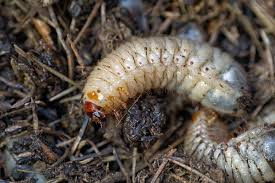
Grub - derived from the verb and thus 'the digging insect', in turn this is from Proto-Indo-European ghrebh 'to dig, bury'.
Hornet - there is no doubting this is from 'horn', but whether this refers to the instrument and thus the buzzing sound of the creature or to the sharp feel of its sting is unknown. Interestingly as the first instruments known as horns were likened to the shape of the animal horn, both share an origin.
Katydid - named for the sound made when the male vibrates its wings. Of more interest is the alternative name for the insect, again imitative of the males but said to sound more like "Katy didn't".
Ladybird - or in the USA the ladybug, the latter are far more sensible name as it clearly is not a bird - although better still was the earlier name of 'ladyfly'. The 'lady' here is the Virgin Mary, which can be seen better in the German Marienkafer.
Locust - shares an origin with the name of the lobster, indeed the French form is languste and the Latin locusta meaning both 'locust' and 'lobster'. Now onbviously it referred to any multi-limbed creature with an external skeleton but, other than that, the etymology is a mystery. Note the Latin lacerta is the only other word known to refer to two quite different creatures, in this case the lizard and the mackerel.
Louse - a parasitic insect and one which has been with humankind for so long its name has never changed, at least not since Proto-Indo-European lus.
Mantis - often referred to as a 'praying mantis', where the first element is superfluous as the name 'mantis' comes from the Greek mantis meaning 'one who divines, prophet'.
Millipede - as with centipede (see above) this combines Latin and Proto-Indo-European to give 'a thousand feet', although the most ever discovered had 750 feet.
Mite - can be traced to Proto-Indo-European mei 'small', something which is seen as another meaning of the word 'mite' today. And before anyone points this out, I know a mite is an arachnid, not an insect.
Mosquito - is a Spanish word, itself derived from Latin musca 'fly' and ultimately the Proto-Indo-European mu 'gnat, fly'.
Nit - little change in this, the egg of the louse (see above), since Proto-Indo-European knid which referred to exactly the same thing today.
Spider - an obvious name when we realise this can be traced back to Proto-Indo-European spen meaning 'stretch, draw, spin' and thus the spider is literally 'the spinner'. And before anyone points this out, I know a spider is an arachnid, not an insect.
Tarantula - named from the seaport city of Taranto in southern Italy where these spiders are frequently found, as a place name it is thought to come from darandos 'oak trees'. And before anyone points this out, I know a trarantula is an arachnid, not an insect.
Termite - began as the Latin terere 'to rub, erode', then termes 'woodworm, white ant', and then to Modern Latin termites, pronounced as three syllables: 'ter-mi-tees', which was mistakenly thought to be plural and the final 's' dropped to produce an apparent singular.
Wasp - no matter how far back we trace this word it, like 'bee' (see above), has only ever meant 'wasp'. It is likely related to webh meaning 'to weave' and a reference to the production of the nest.
Weevil - exactly as 'wasp' (see above) in coming from Proto-Indo-European webh 'to weave'.
Ant - a Germanic term, seen in Old English aemette which is why it is still known in the southwest of Britain as the 'emmet', and coming from the Germanic root ai 'off, away' and Proto-Indo-European mai 'to cut' (a word which has also given us 'maim'). Thus the ant or emmet is actually 'the biter-off', a reference to how the creatures chop up larger prey to take back to their nests.
Aphid - the gardener's traditional enemy has an odd name which has never been understood. It is unknown before 1758, the colloquial name of ant-cow from 1847, when it was apparently coined by Linnaeus as aphides, the plural of aphis. Here the trail goes cold, although it has been suggested this comes from Greek apheides meaning 'unsparing, lavishly bestowed' and a reference to its unbelievable rate of production. While this etymology seems plausible there is nothing to show it to be true. What is true is their prodigous breeding capability for, under optimal conditions and with no predation, disease. parasites, and unlimited food supplies, a single female aphid can, through asexual reproduction, theoretically produce 600,000,000,000 (six hundred billion) descendants in a single season. Now you see why insects have been suggested as the answer to the world's food problem - although it doesn't answer the question the aphids ask about their food problem.
Bee - since humanity's days as hunter-gatherers honey will have been an important natural resource. Freely available, albeit not easily gathered, nutritious, sweet (and who doesn't like sweet), and with a long shelf life, it was the answer to many needs. Hence there has been a long association with the bee and that is reflected in the name. Coming from Old English beo, Old Norse by, Old High German bia, Middle Dutch bie, Proto-Germanic bion, and Proto-Indo-European bhei, all mean simply 'bee' and thus the name of this now worryingly endangered insect has not only never changed but has always been imitative of the buzzing sound associated with it.
Beetle - from Old English bitela, itself from Proto-Germanic bitel 'biting', and ultimately traceable to the Proto-Indo-European bheid 'to split' and referring to the formidable mandibles of beetles.
Caterpillar - the larval stage of butterflies and moths does not have a name it can call its own for, no matter what it is known as and from what language, the creature is always alluded to as resembling something else. For example, the English 'caterpillar' came from Old French chatepelose or 'shaggy cat'. Nothing different in other tongues, Swiss German teufelskatz 'devil's cat', Milanese cagnon 'little dog', Italian gattola 'little cat', Portuguese lagarta 'lizard', and Kentish where it was either a 'hop-dog' or 'hop-cat'.
Centipede - simply unites Latin centum and Proto-Indo-European ped 'foot' - although known centipedes have anything from 30 to 354 legs (or 15 to 177 pairs) and always an odd number of pairs of legs and therefore no centipede can have a hundred legs (see also millipede).
Chafer - a kind of beetle taking its name for a similar reason. Here Proto-Germanic kabraz meant 'gnawer' and came from Proto-Indo-European geph 'jaw, mouth'.
Cricket - comes from the Old French criquet from criquer, which means exactly what it sounds like 'creak, rattle'.
Dragonfly - is a fairly modern name, dating from the early 17th century and an example of folklore more than its earlier name of adderbolt, a good description of its shape and movement.
Earwig - named because it was thought the the wicga 'beetle, worm, insect' would be likely to hide inside the human ear - French perce-oreille and German ohr-wurm give the same warning - although there is not a single recorded instance of any earwig found in any earhole throughout the entire human history. The term wicga shares an origin with 'wiggle' in Proto-Indo-European wegh 'to go, move'. Also worth noting is the old dialect term from the north of England, where it was known as a 'twitch-ballock'.
Flea - see 'fly' below.
Fly - this is from the sense of movement through air, but this comes from the word 'flee' (as is 'flea' above) as it was the fastest means of escape. Here 'flee' comes from Proto-Indo-European pleuk, from the root pleu 'to flow'.
Gnat - shares a root with 'gnaw' as this means 'biter' but understood as 'little biter'.
Grasshopper - is basically the same thing as a locust, except from time to time the locust form vast swarms. The name is obvious, unlike the locust (see below), referring to its movement and habitat.
Greenfly - obviously some are indeed green and they are capable of flight.
Grub - derived from the verb and thus 'the digging insect', in turn this is from Proto-Indo-European ghrebh 'to dig, bury'.
Hornet - there is no doubting this is from 'horn', but whether this refers to the instrument and thus the buzzing sound of the creature or to the sharp feel of its sting is unknown. Interestingly as the first instruments known as horns were likened to the shape of the animal horn, both share an origin.
Katydid - named for the sound made when the male vibrates its wings. Of more interest is the alternative name for the insect, again imitative of the males but said to sound more like "Katy didn't".
Ladybird - or in the USA the ladybug, the latter are far more sensible name as it clearly is not a bird - although better still was the earlier name of 'ladyfly'. The 'lady' here is the Virgin Mary, which can be seen better in the German Marienkafer.
Locust - shares an origin with the name of the lobster, indeed the French form is languste and the Latin locusta meaning both 'locust' and 'lobster'. Now onbviously it referred to any multi-limbed creature with an external skeleton but, other than that, the etymology is a mystery. Note the Latin lacerta is the only other word known to refer to two quite different creatures, in this case the lizard and the mackerel.
Louse - a parasitic insect and one which has been with humankind for so long its name has never changed, at least not since Proto-Indo-European lus.
Mantis - often referred to as a 'praying mantis', where the first element is superfluous as the name 'mantis' comes from the Greek mantis meaning 'one who divines, prophet'.
Millipede - as with centipede (see above) this combines Latin and Proto-Indo-European to give 'a thousand feet', although the most ever discovered had 750 feet.
Mite - can be traced to Proto-Indo-European mei 'small', something which is seen as another meaning of the word 'mite' today. And before anyone points this out, I know a mite is an arachnid, not an insect.
Mosquito - is a Spanish word, itself derived from Latin musca 'fly' and ultimately the Proto-Indo-European mu 'gnat, fly'.
Nit - little change in this, the egg of the louse (see above), since Proto-Indo-European knid which referred to exactly the same thing today.
Spider - an obvious name when we realise this can be traced back to Proto-Indo-European spen meaning 'stretch, draw, spin' and thus the spider is literally 'the spinner'. And before anyone points this out, I know a spider is an arachnid, not an insect.
Tarantula - named from the seaport city of Taranto in southern Italy where these spiders are frequently found, as a place name it is thought to come from darandos 'oak trees'. And before anyone points this out, I know a trarantula is an arachnid, not an insect.
Termite - began as the Latin terere 'to rub, erode', then termes 'woodworm, white ant', and then to Modern Latin termites, pronounced as three syllables: 'ter-mi-tees', which was mistakenly thought to be plural and the final 's' dropped to produce an apparent singular.
Wasp - no matter how far back we trace this word it, like 'bee' (see above), has only ever meant 'wasp'. It is likely related to webh meaning 'to weave' and a reference to the production of the nest.
Weevil - exactly as 'wasp' (see above) in coming from Proto-Indo-European webh 'to weave'.
Sunday, 9 September 2012
Butterflies and Moths – the viewpoint of an etymologist, not an entomologist
In Britain there are some three thousand species of lepidoptera, eighty-five per cent of which are moths. For many years the mere mention of a fritillary or skipper has piqued my interest, just why were such unusual names chosen to describe moths and butterflies?
Clearly with such a vast array of these insects the etymologies of all of them cannot be covered in a single article. Hence we shall look at the most common and the families or groups. Indeed the vast majority of the names include a colour or shape, which require little or no explanation. Examples include the swallowtails, however the hairstreaks are also quite easy to explain, the fine stripes beneath the wings giving them their collective name.
Argus was a character in Greek mythology with a hundred eyes, the argus butterflies are typically brown and have wings with very eye-like spots. Fritillary is derived from a word in Modern Latin referring to 'dice box', this is most likely a reference to the wing spots, said to resemble the spots on dice. Brimstones are named for their colour, they are predominantly yellow.
Peacocks are butterflies named for the four eye-like spots on the wings which very much resemble those 'eyes' on the splendid tale of the male bird with which it shares its name. With a shape underneath the hind wings, the comma butterfly takes its name from the spots said to resemble such punctuation. Ghost Moths get their name from the display flight of the male, hovering in a display area with other males and sometimes slowly rising and falling in what is seen as typical ghostly behaviour. These are also referred to as part of the Swift group of moths, rather obviously speaking of their comparatively speedy flight.
Leopard moths take their name from the wing spots, although none resemble those of the big cat. Festoon moths have patterns which resemble a festoon, a string or chain of flowers, ribbons, leaves, etc. Hornet moths are named for their yellow stripes. Clearwings have just that, although faintly patterned would be a more accurate description.`
Another group are the foresters, which generally speaking enjoy a woodland habitat. However these were categorised when first identified and some either were mistakenly classified as such or simply have had to find alternative habitats. The lappet group have wings having a shape resembling the distinctive fold in headgear and clothing of Victorian times, also known as lappets. Hook-tips, as the name suggests, have a distinct hook on the tip of the wing.
Those named from their flight include the skippers, a group which includes the smaller skipperlings, which are characterised by their tendency for short flights with exaggerated jerking movements. No surprise to find the December moth is seen flying in that month, however it is more commonly spotted in the previous two months.
The delightfully named Gatekeeper Butterfly is a species which is found in hedges and meadow margins. For this reason it is often seen sunning itself on posts and gates of fields. Presumably it also did so when tollgates littered the country and butterflies where much more numerous than today. The Puss moth is named because of its rather hairy appearance, the Kitten moth is named because they appear a smaller version of the Puss moth. Tussock moths are very hairy, so much so the hairs often disguise the fact they are moths.
Processionary moths are known as such for they wander around in single file as caterpillars when searching for food sources. Footmen are named for having bright colours likened to the uniforms of those from the royal courts. Similarly the tigers, handmaid and muslin species are all said to resemble such.
Doubtless there are many more species of butterfly and moth to be discovered, assuming scientists identify them before man's need for land destroy these habitats. It is highly likely these new species will be named for their discoverers, as is the norm today, rather than the delightfully creative names of yesteryear.
I would welcome any suggestions for themes or subjects, or even specific words to examine the origins, meanings and etymologies. I’d be delighted to hear from you.
Clearly with such a vast array of these insects the etymologies of all of them cannot be covered in a single article. Hence we shall look at the most common and the families or groups. Indeed the vast majority of the names include a colour or shape, which require little or no explanation. Examples include the swallowtails, however the hairstreaks are also quite easy to explain, the fine stripes beneath the wings giving them their collective name.
Argus was a character in Greek mythology with a hundred eyes, the argus butterflies are typically brown and have wings with very eye-like spots. Fritillary is derived from a word in Modern Latin referring to 'dice box', this is most likely a reference to the wing spots, said to resemble the spots on dice. Brimstones are named for their colour, they are predominantly yellow.
Peacocks are butterflies named for the four eye-like spots on the wings which very much resemble those 'eyes' on the splendid tale of the male bird with which it shares its name. With a shape underneath the hind wings, the comma butterfly takes its name from the spots said to resemble such punctuation. Ghost Moths get their name from the display flight of the male, hovering in a display area with other males and sometimes slowly rising and falling in what is seen as typical ghostly behaviour. These are also referred to as part of the Swift group of moths, rather obviously speaking of their comparatively speedy flight.
Leopard moths take their name from the wing spots, although none resemble those of the big cat. Festoon moths have patterns which resemble a festoon, a string or chain of flowers, ribbons, leaves, etc. Hornet moths are named for their yellow stripes. Clearwings have just that, although faintly patterned would be a more accurate description.`
Another group are the foresters, which generally speaking enjoy a woodland habitat. However these were categorised when first identified and some either were mistakenly classified as such or simply have had to find alternative habitats. The lappet group have wings having a shape resembling the distinctive fold in headgear and clothing of Victorian times, also known as lappets. Hook-tips, as the name suggests, have a distinct hook on the tip of the wing.
Those named from their flight include the skippers, a group which includes the smaller skipperlings, which are characterised by their tendency for short flights with exaggerated jerking movements. No surprise to find the December moth is seen flying in that month, however it is more commonly spotted in the previous two months.
The delightfully named Gatekeeper Butterfly is a species which is found in hedges and meadow margins. For this reason it is often seen sunning itself on posts and gates of fields. Presumably it also did so when tollgates littered the country and butterflies where much more numerous than today. The Puss moth is named because of its rather hairy appearance, the Kitten moth is named because they appear a smaller version of the Puss moth. Tussock moths are very hairy, so much so the hairs often disguise the fact they are moths.
Processionary moths are known as such for they wander around in single file as caterpillars when searching for food sources. Footmen are named for having bright colours likened to the uniforms of those from the royal courts. Similarly the tigers, handmaid and muslin species are all said to resemble such.
Doubtless there are many more species of butterfly and moth to be discovered, assuming scientists identify them before man's need for land destroy these habitats. It is highly likely these new species will be named for their discoverers, as is the norm today, rather than the delightfully creative names of yesteryear.
I would welcome any suggestions for themes or subjects, or even specific words to examine the origins, meanings and etymologies. I’d be delighted to hear from you.
Labels:
Butterfly,
entomology,
Etymology,
insect,
Lepidoptera,
meanings,
moth,
names,
Origins,
words
Subscribe to:
Posts (Atom)