A few will be aware I have been known to speak on various subjects over the years. Fundamentally these all revolve around my favourite subject of etymology. Have always enjoyed bringing this fascinating subject to others. It’s not for me to say whether the audiences have, although many have asked me to return.
Thought it might be worthwhile sharing a snippet or two from these etymological presentations, continuing with Etymology for the Writer or Artist. Every artist knows the names of the techniques and methods used to produce that painting, sculpture, or moulding, while writers are well-acquainted with parts of speech, tenses and grammar. But how many artists really know how a technique, style, or even a colour got its name? Are writers aware of why a noun, verb, or adjective is known as such? And very few will understand just why tenses are known as they are - I mean who ever though the 'pluperfect' sounded remotely useful as a term? Not simply a lesson in etymology this is a very different way of looking at history and how the English language developed over several centuries.
Created for the many writing groups I have spoke to, it made a change for them from the usual guests who either tell them about themselves or attempt to inspire their writing. A couple of examples from the origins of our alphabet.
A – derived from the Greek alpha. Used in the modern sense to mean ‘the first’ dates from the 17th century. The Greeks got it from the Hebrew and/or Phoenician aleph (greek not permitting the use of consonants at the end of words so they added the ‘a’) and this, in turn, from the Semitic group of languages where eleph literally meant ‘ox’. It is thought the character represents the head of an ox.
O – from the Greek omicron and a meaning of ‘small o’, this from the Proto-Indo-European word smik or ‘small’ as this is a notably small vowel. As a letter it is derived from the Phoenician ayn or ‘eye’, itself taken from the Egyptian hieroglyph of an eye. O is also represented by omega, a comparatively late addition to the Greek alphabet and not seen until around 2,800 years ago. It is related to omicron and means ‘great o’ as in literally ‘o - mega’. If you want to know the diffidence between omicron and omega simply look at the word ‘lotto’, where the short version is near the beginning and the longer at the end.
P – comes from the Greek pi and itself from the Phoenician pe which, in turn, comes from the pictogram of a mouth.
Z – comes from the sixth letter of the Greek alphabet zeta and it is also the basis for our modern letter Z. Derived from the Hebrew zayin, literally meaning ‘weapon’ and likely a reference to its shape resembling a jagged edge.
G – if you’ve ever wondered why we have two pronunciations for the letter G – as in Gary and George – it is purely down to source. The hard G in Gary is Germanic, the softer G in George is from Latin and prior to that Greek. In fact the latter G did exist in the Latin alphabet but was written as a Z (try saying George with a Greek accent but spelling it with a Z, it works).
If you think you know someone who would like to hear me speak on this subject, drop me a line.
Showing posts with label Germanic. Show all posts
Sunday, 9 August 2026
Sunday, 16 April 2023
Homonyms, Etymologically Speaking: W
Many words have two meanings, sometimes more, which are often very different. Such words have identical spelling and pronunciation, they are known as homonyms. Here I continue an A to Z list of such words and look at how that word came to have two different meanings.
W is for watch, be it the timepiece or simply to observe. The latter is seen in Old English waecce 'state of being awake'; from Proto-Germanic wakjan and Proto-Indo-European weg 'be strong, lively'. Hence watchfulness and awake are ostensibly the same thing.
The timepiece is seen from 1580, and was a device to waken sleepers who would then be 'on watch' in the next crew rotation.
W is for watch, be it the timepiece or simply to observe. The latter is seen in Old English waecce 'state of being awake'; from Proto-Germanic wakjan and Proto-Indo-European weg 'be strong, lively'. Hence watchfulness and awake are ostensibly the same thing.
The timepiece is seen from 1580, and was a device to waken sleepers who would then be 'on watch' in the next crew rotation.
Sunday, 8 January 2023
Homonyms, Etymologically Speaking: I
Many words have two meanings, sometimes more, which are often very different. Such words have identical spelling and pronunciation, they are known as homonyms. Here I continue an A to Z list of such words and look at how that word came to have two different meanings.
I is for iron and today possibly the use for the metal may be falling behind the use for the pressing of clothes. The metal is clearly the oldest of the uses, indeed there is even an Iron Age referring to a stage of technological advances where iron was smelted, an improvement on the earlier Bronze Age. The word is first seen in Old English iren, from Proto-Germanic isarn, and probably loaned from isarnon of the Celtic languages and ultimately from Proto-Indo-European eis meaning 'strong'. Hence the idea is this newly smelted metal was much stronger than bronze and appropriately named as 'the strong metal'. Related terms are seen in Sanskrit isirah 'vigorous, strong' and Greek ieros 'strong' and, through the context in which these terms were used, is thought to have been seen as 'the holy metal'.
The other sense of 'iron', that of removing creases from clothing, stems from that metal being used to produce the tool. For much of its life it has been known as a flat iron, and not until 'to iron' was seen as a verb (hence we do the ironing) was it known as an iron.
I is for iron and today possibly the use for the metal may be falling behind the use for the pressing of clothes. The metal is clearly the oldest of the uses, indeed there is even an Iron Age referring to a stage of technological advances where iron was smelted, an improvement on the earlier Bronze Age. The word is first seen in Old English iren, from Proto-Germanic isarn, and probably loaned from isarnon of the Celtic languages and ultimately from Proto-Indo-European eis meaning 'strong'. Hence the idea is this newly smelted metal was much stronger than bronze and appropriately named as 'the strong metal'. Related terms are seen in Sanskrit isirah 'vigorous, strong' and Greek ieros 'strong' and, through the context in which these terms were used, is thought to have been seen as 'the holy metal'.
The other sense of 'iron', that of removing creases from clothing, stems from that metal being used to produce the tool. For much of its life it has been known as a flat iron, and not until 'to iron' was seen as a verb (hence we do the ironing) was it known as an iron.
Sunday, 27 February 2022
The Mean; You're Mean; I Mean.
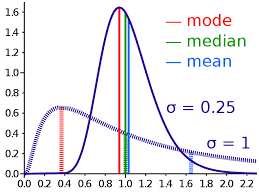
Following on from several weeks featuring an alphabetical list of words which had previously had rather different meanings, I found myself thinking about the different uses of the word 'mean'. How can so many different usages have come from the just placing four letters in the same order? Surely it can't be purely random? There are three in the title - an adjective, a verb, and a noun - but there are actually six different uses, with three adjectives and two verbs.
We will start with a verb. 'Mean', as in 'intend' comes to English from the Germanic tongues, and ultimately from that original Proto-Indo-European language where the root of meino can be defined as 'opinion' as well as 'intent'.
As one of the adjectives, the sense is now largely obsolete as 'shared by all, common, general'. This came from Proto-Indo-European ko-moin-i 'held in common', itself with the root mei 'to change'.
As the noun 'mean' is 'the midway point between two extremes' as opposed to the average. This is reflected in the Proto-Indo-European root medhyo 'middle'.
The second use as a verb is derived from the above noun, this then to 'calculate the middle value' and has the same origins.
The second adjective describes one of middle rank or status, again having a common root with the noun but coming to English with the French, in words such as moiien 'medium' or even 'middle-class', and Latin medius 'in the middle'.
The third adjective is an abbreviation, and was originally used as 'mean-spirited', the latter used from the late 17th century when 'mean' was used as a synonym for 'stingy'. With the addition of '-spirited' the use changed to describe one as 'spineless, grovelling' and latterly has been used instead of 'cruel'.
Thus, the reason we have five meanings for what appears to be one word, is because these are five different words which have taken on the same spelling in English.
We will start with a verb. 'Mean', as in 'intend' comes to English from the Germanic tongues, and ultimately from that original Proto-Indo-European language where the root of meino can be defined as 'opinion' as well as 'intent'.
As one of the adjectives, the sense is now largely obsolete as 'shared by all, common, general'. This came from Proto-Indo-European ko-moin-i 'held in common', itself with the root mei 'to change'.
As the noun 'mean' is 'the midway point between two extremes' as opposed to the average. This is reflected in the Proto-Indo-European root medhyo 'middle'.
The second use as a verb is derived from the above noun, this then to 'calculate the middle value' and has the same origins.
The second adjective describes one of middle rank or status, again having a common root with the noun but coming to English with the French, in words such as moiien 'medium' or even 'middle-class', and Latin medius 'in the middle'.
The third adjective is an abbreviation, and was originally used as 'mean-spirited', the latter used from the late 17th century when 'mean' was used as a synonym for 'stingy'. With the addition of '-spirited' the use changed to describe one as 'spineless, grovelling' and latterly has been used instead of 'cruel'.
Thus, the reason we have five meanings for what appears to be one word, is because these are five different words which have taken on the same spelling in English.
Sunday, 29 March 2015
A Tree of Indo-European Languages
Over the last few weeks I have looked at the origins of the names of cities from many European countries. In doing this I wanted to examine the links between the various languages by comparing the elements which make up these names to English place names.
Last time I looked at Greek places which, for the most part, were derived from mythological figures. Conversely many of the other place names are derived from words which ultimately can be traced to more ancient tongues. Without a doubt the most commonly mentioned early language is Greek. In truth this is probably because more is known about this particular language than any other of comparable age.
I thought this might the ideal time to take a short break from looking at the place names and take a brief glimpse into the Indo-European group of languages and examine the family tree. The following image will show the development best of all. Note the timelines are approximate and only represent the first accepted appearance of a distinct tongue.
It is worthwhile highlighting the languages which have resulted in the majority of English place names. The Celtic languages first emerged and diversified around five thousand years ago, around the same time as the Germanic and Italic groups. The Celtic tongues have produced many of the topographical names, while the Germanic group contains Old English and Old Scandinavian, the two tongues which have contributed more to English place names than any other.
Last time I looked at Greek places which, for the most part, were derived from mythological figures. Conversely many of the other place names are derived from words which ultimately can be traced to more ancient tongues. Without a doubt the most commonly mentioned early language is Greek. In truth this is probably because more is known about this particular language than any other of comparable age.
I thought this might the ideal time to take a short break from looking at the place names and take a brief glimpse into the Indo-European group of languages and examine the family tree. The following image will show the development best of all. Note the timelines are approximate and only represent the first accepted appearance of a distinct tongue.
It is worthwhile highlighting the languages which have resulted in the majority of English place names. The Celtic languages first emerged and diversified around five thousand years ago, around the same time as the Germanic and Italic groups. The Celtic tongues have produced many of the topographical names, while the Germanic group contains Old English and Old Scandinavian, the two tongues which have contributed more to English place names than any other.
Subscribe to:
Posts (Atom)