Sunday, 10 April 2022

Synonym Etymologies C

Continuing the look at synonyms through the eyes of the etymologist, this time it is the letter C for Cry as in weep.

Cry was originally used to mean 'to utter loudly' and the use of 'cry' as in 'weep' is derived from that. Hence the etymology is the same, but aside from the Spanish cridar, Portuguese gritar and Latin quiritare, all have the same meaning of 'wail, shriek', the source is unknown. What is known, and quite astonishing, is to find that nobody 'cried' before 1852, other synonyms were used, some of which follow.


Weep is a Germanic word and has always meant the same as it does today, it is derived from Proto-Indo-European wab with exactly the same meaning.

Tear can be traced back to the Proto-Indo-European dakru, which was not only used to refer to teardrops, but any liquid drops.


Howl, again, likens tears to crying out loud, and has exactly the same origin as 'owl', both of which are imitative of the whatever they are describing - effectively the phonetic spelling of the sound has become the word.

Bawl comes from the Old Norse baula meaning 'to low like a cow'. A reasonable description I would think.

Snivel is from the Old English snyflan and describes 'the running of the nose', this also linked to tears.

Whimper is another Germanic word of imitative origins.

Sob, held to be crying with short breaths, is first used in Old English to mean 'lament', and is derived from a Germanic root meaning 'to suck'.


Wail is derived from the same source as 'woe' and from Old Norse vaela 'lament'.


Skrike is a word I have only ever heard two people use - my mother and my grandmother. I assumed it was another of my grandmother's odd Black Country expressions - she inspired both my Old Wives Tales and Odd Words and Sayings both of which feature her image on the cover - and yet I find it is known as a regional expression which are usually used to refer to the cry of the crow, thus another imitative word.

Sunday, 3 April 2022

Synonym Etymologies B

As with the last post, a look at a number of synonyms through the eyes of the etymologist. This time B for Bag, which is from the Old Norse baggi 'pack, bundle'. Some sources give the origin as Old French bague, which could explain its longevitry in having been introduced to English twice, but as this would also have come from the Old Norse, too, it is hardly relevant.

Sack is known as such because of the material it is made from. Usually known as 'sacking' in English, many European languages have borrowed the early Greek sakkos 'bag made of goat hair', itself related to Hebrew and Phoenician saq 'cloth of hair'.


Carrier is clearly from the verb 'to carry'. Coming to English from old French, it can be traced to Latin carricare and derived from Latin carrum, their name for the 'Celtic two-wheeled war chariot'. We can even trace this further back to that source of many languages, the root language which spread across India, Middle East, and Europe with the retreating of the ice sheets, the Proto-Indo-European root kers meaning 'to run' - this is also the origin of the word 'horse'.


Receptacle, from Old French in the 14th century, has the same origin as its parent word 'receive', which is traceable back through Latin to Proto-Indo-European kap 'grasp'.

Container, clearly from 'contain', is another which came to English from Old French and further back Latin. The Latin coninere was used in the sense of 'to hold together, enclose', and comes from Proto-Indo-European ten 'to stretch'. Not until the 14th century did the idea of 'hold together' become seen as also conveying the sense of 'containing'.

Bag again, this time as a verb, not the noun as above. In the sense of killing or capturing prey (or even criminals), its use is unrecorded until 1818. Clearly this refers to the game, a bird or rabbit, to be placed in the bag. Now, that the bag would swell is more the reason for the use of 'bag' here, rather than the bag itself. We know this as the word 'bag' had been used to refer to loose fitting clothing and, usually to animals, particularly livestock, to the swelling of a belly when pregnant and had been since the late 14th century.


Catch has exactly the same origins as 'receptacle' and 'receive', traceable to Proto-Indo-European kap 'to grasp'. The difference is largely how the word came through the later Latin and Old French routes.

Capture is also from Proto-Indo-European kap, and much easier to see.

Snare, as a verb, comes from the noun, This noose for trapping animals is from the Old Norse soenri or 'twisted rope'. Neither verb nor noun used in English until around 1300.


Kill, be it a noun or a verb, must surely be an old word, and indeed it does go back to Proto-Indo-European through the Germanic route to English. Working back in history, usage has meant not only 'kill, put to death', but also 'die', 'torment', 'tease', 'suffer pain', and ultimately Proto-Indo-European gwele 'to throw' and also used in the extended sense of 'to pierce'.

Shoot can be traced back through the German line and originaly used in the sense 'to push, shove, impel', which is effectively what the bow does to the arrow and the gun to the bullet.

Sag used to refer to body parts and/or clothes in the mid-16th century, it is from an Old Norse root sokkva 'to sink'.

Swell has been used to mean 'to grow bigger' for so long and virtually unchanged and in so many Germanic tongues it is impossible to know where the word originated.

Balloon, as a verb, comes from the noun, itself a derivative of 'ball' and the Latin palla. The idea of the balloon and the ball in these old tongues, come from the original Proto-Indo-European bhel which meant 'to swell, and thus the word has returned to its original use after several thousand years.


Bulge is not difficult to see as related to 'balloon' and it does also go back to the Proto-Indo-European bhel.

Synonym Etymologies A

Reading a very boring and tedious book - the author won't mind me saying so as he's been dead for well over a hundred years - I read a list of words with identical meaning. (The author clearly did it to annoy me and not to emphasise his point.) So transfixed was I by his 676-page drone, my mind wandered and I found myself thinking about the etymologies of each of these words and whether they had anything in common. I suspected, from the various forms, that many would have had very different usages and meanings in the past - such discussed in earlier blog posts for some twenty posts up to the 16th January 2022.

I decided I would take this, as with the earlier posts, in alphabetical order and thus begin with a word which would never describe me when reading the book, for A for Alert, which we take first as a verb. It came to English from the French in the early 17th century, where a l'erte translates as 'on the watch'. Here the last element is related to the Latin erta 'a high tower'.

Vigilant is another from French, coming to English in the late 15th century, itself directly from Latin vigilantem. Both have idential meanings but can be traced back further to Proto-Indo-European weg 'strong, lively'.

Awake is first seen in the earlier Middle English form awaecnan 'to arise, originate'. Trace this back through the Germanic line and we come to the same root, that of Proto-Indo-European weg 'strong, lively'. Note the original use as 'awaken' meant specifically 'to rouse from sleep', and only later changed usage.

Aware is another through the Germanic line, where early forms saw Old High German ga-waraz 'be wary'. Again a Proto-Indo-European rouut, this time wer 'perceive, watch for'.

Watchful is seen from around 1500, with two elements which we will look at seperately. The suffix 'ful' is clearly intended to describe the amount of the other element, and always intended to show there was plenty of whatever that was. Of more interest is the Old English and Middle English words using this element, where it would inevitably come before the other element as a prefix, not a suffix. 'Watch' has the same origins as 'wake', ultimately from to Proto-Indo-European weg 'strong, lively'.

Attentive is another Old French derivation, where atentif meaning 'expectant, hopeful'. This came from the Latin attendere meaning 'give heed to' and has also given us 'attend'. Sadly the trail has not been traced further back in history.

Observant is seen in English since around 1600, unchanged from its French version but with a slightly different meaning. In French observant makes much more sense in meaning 'paying due attention to what is required'.

Wary we have already seen above in looking at 'aware'. Different word but same etymology and history.

Canny is Scotland and northern England dialect derived from 'cunning', this from Old English cunnan and ultimately the Proto-Indo-European root gno or 'to know'. To return to 'canny' for a moment, in Scotland three centuries ago the usage would be more 'lucky, prudent, skillful'. Even more unusual was 'uncanny', which rather than meaning the opposite, was used to mean 'dangerous'. Isn't language wonderful?


Heedful is another with two elements and, as we have already looked at the suffix under 'watchful', we will look at 'heed'. It has a Germanic origin, where we find hodian, hoda, hoeden, huotan, huten and others in several Germanic tongues, all of which can be traced to Proto-Indo-European kadh meaning 'shelter'. Indeed, all these Germanic words can also be seen in the etymology of 'hat'. While 'shelter' to 'hat' makes perfect sense, 'shelter' to 'observe, attend' takes a lot more thought.

Circumspect has two elements, the prefix is readily seen as meaning 'look around', while the rest is from Proto-Indo-European spek 'to observe'.

Care is next - note, previously the words have been verbs and/or adjectives, but from hereafter nouns - and another word of Germanic origins. Old English cearian 'be anxious' gives a clue to earlier meanings, for the original Proto-Indo-European gar or 'cry out, call, scream' is closer related to 'compain, lament' than the 'take heed' sense today. Interesting to note the word 'garrulous', a seemingly complex word, is much closer to the original gar and with more or less the same 'verbose' meaning.


Caution or 'to warn' comes from the noun, itself derived from the same word in Old French, where it meant 'security'. Both the French and the Latin cautionem are derived from Proto-Indo-European keu 'observe, perceive'.

Wariness has the suffix seen in many historical Western European languages, and always the same meaning, following a word we have already seen twice above in 'aware' and 'wary.

Alertness features the same suffix, 'ness', with the word we came in with. Thus roughly half have the same origin, ostensibly always having the same meaning, while the remainder have wandered from the original sense but mostly understandably.

Sunday, 20 March 2022

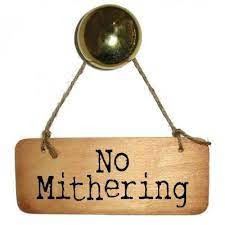
Mithering

Gave a talk a couple of months ago, a look at some of the more amusing etymologies. As always I gave the audience the opportunity to ask questions at the end, which resulted in this piece.

In all honesty I didn't know the answer to the question when it was asked. But some of you will understand when I say if I'm asked a question it will not stop coming back to mind until such time as I've answered it. I did forget for a couple of days but eventually the recurring memory forced me to answer the query.


The question was asked by a lady who, being of Welsh origin, indeed a Welsh speaker, could never understand why her husband, he born and bred in Lancashire, used the verb 'to mither' - as in 'Stop mithering me, woman!' Incidentally, just to increase the confusion further, this question was asked in Surrey, where very few of the others had heard of the term either. Indeed, it seems 'mither' is a word mostly used in the Midlands and the North of England.


I looked, and while the origins are not overly certain, the word first appears in the late 17th or early 18th century. It is thought to be derived from moedrodd meaning 'to worry, bother'. The irony here being that moedrodd is a Welsh word, the same language as the lady accused of the 'mithering' stated was her native language. I did email the answer to the group and they responded and copied in the husband and wife so they could see the answer.

As of today I have not had an answer. Perhaps they thought I was mithering? Oh, and the drink below is a cocktail known as a 'mithering bastard'.

Sunday, 13 March 2022

Dogs

As last time, when researching I do sometimes come across a piece which is possibly not intended to be amusing, but I found it so and for that reason I shall share it. This comes from the Birmingham Daily Post dated 7th November 1894.

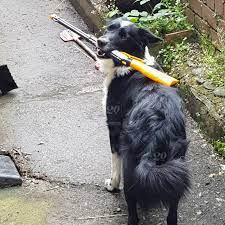
The Essex coroner held an inquest on Monday night on the body of Mr James Cornwell, of Castle Hedingham, who was found with a gunshot wound in his head, lying in a ditch in the neighbourhood, on Saturday. Mr Cornwell left his home on Friday night to go to a neighbouring village. He had with him his gun, and was accompanied by a collie dog. As he did not return in the evening a search was made for him, and on the following day his lifeless body was found in a ditch near Long Crofts. The left barrel of the gun had been discharged, and there was a bramble between the triggers. The face was shattered by a gunshot. The collie was found watching by the side of its master, and refused to allow the body to be touched until Mrs Cornwell arrived. The jury returned a verdict of "Accidental death",

I have to say the actions of the dog after the body was found did make me wonder whether it had planted the evidence of the bramble, and refused to let anyone approach until it was sure the man was dead. But then if dogs were really that smart, owners would simply tell them to 'shit in this bag'.

Some may realise this is the same date as that of the killer cat story last time. It did make me wonder of if the editor of the Birmingham Daily Post had collected such tales (not tails) for a slow news week.

Sunday, 6 March 2022

Cats

Sometimes when researching I come across a piece which is possibly not intended to be amusing, but I found it so (possibly because of her surname) and for that reason I shall share it. This comes from the Birmingham Daily Post dated 7th November 1894.

Mr. Wynne E. Baxter held an enquiry in London, yesterday, respecting the death of Emma Kipper, aged fifty-eight, the wife of a carpenter. On the 10th of last month deceased crossed her room, when she trod on the tail of her cat, which turned round and bit her on the back of the leg. She said she felt the teeth go right to the bone. She became very ill, and was removed to the hospital, when it was found that there were wounds on the back of the left foot and a portion of the leg was gangrenous. The cause of death was infective spreading gangrene, the origin of which was possibly the bite of the cat. The jury returned a verdict of "Accidental death through the bite of a cat."

Sunday, 27 February 2022

The Mean; You're Mean; I Mean.

Following on from several weeks featuring an alphabetical list of words which had previously had rather different meanings, I found myself thinking about the different uses of the word 'mean'. How can so many different usages have come from the just placing four letters in the same order? Surely it can't be purely random? There are three in the title - an adjective, a verb, and a noun - but there are actually six different uses, with three adjectives and two verbs.

We will start with a verb. 'Mean', as in 'intend' comes to English from the Germanic tongues, and ultimately from that original Proto-Indo-European language where the root of meino can be defined as 'opinion' as well as 'intent'.


As one of the adjectives, the sense is now largely obsolete as 'shared by all, common, general'. This came from Proto-Indo-European ko-moin-i 'held in common', itself with the root mei 'to change'.

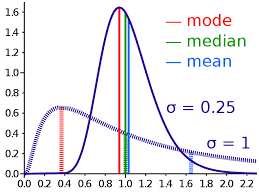
As the noun 'mean' is 'the midway point between two extremes' as opposed to the average. This is reflected in the Proto-Indo-European root medhyo 'middle'.


The second use as a verb is derived from the above noun, this then to 'calculate the middle value' and has the same origins.

The second adjective describes one of middle rank or status, again having a common root with the noun but coming to English with the French, in words such as moiien 'medium' or even 'middle-class', and Latin medius 'in the middle'.

The third adjective is an abbreviation, and was originally used as 'mean-spirited', the latter used from the late 17th century when 'mean' was used as a synonym for 'stingy'. With the addition of '-spirited' the use changed to describe one as 'spineless, grovelling' and latterly has been used instead of 'cruel'.


Thus, the reason we have five meanings for what appears to be one word, is because these are five different words which have taken on the same spelling in English.