Showing posts with label dead. Show all posts

Sunday, 17 December 2023

Horse Idioms

Several words have found themselves used in a number of phrases. We looked at 'water' last time and this time it's 'horse'.

Horseradish is not recorded as such before 1590. Now this is nothing to do with an equine, the first element is used to denote ‘strong, coarse, large’. Indeed. Once English also featured the terms: horsemushroom (1866), horsebalm (1808), horseparsley, horsemussel, horsemint, horseemmet (a large any) and horse marten (a large bee).


Horse latitudes is first used in 1777, although where it came from is anyone’s guess, but does refer to subtropical latitudes known for calm winds and low rainfall.


Horse pistol is seen from 1704, a large pistol used by those on horseback.

A dead horse is something no longer useful, and was used from the 1630s.

Flogging a dead horse, as in trying to revive something without success, is first seen in 1864.


Horsegodmother was a woman seen as rather masculine, first recorded in 1829.

Horse’s mouth, as in information directly from the source (or claimed to be) is first attested in 1921 – thought to have been a racing term first of all.

To swap horses midstream, indicating a bad move, seems to have come to the fore in the American Civil War and some maintain it is a direct quote from the writings of Abraham Lincoln (although Honest Abe never claimed to have coined the phrase, and doubtless won’t now).

Hold your horses – ie slow down a little – first appears in 1842.

Horse play, to lark about, is first seen in 1893.

Horse chestnuts were first named as such in a document from around 1590. Thought to have been named as these were fed to horses.

Clotheshorse, which is something used for drying the washing, dates from 1788. From 1850, the same term was applied to those who liked to show off their attire – also known as a clothes screen in 1830.


Getting on your high horse is first seen in the early 14th century.

Sunday, 13 March 2022

Dogs

As last time, when researching I do sometimes come across a piece which is possibly not intended to be amusing, but I found it so and for that reason I shall share it. This comes from the Birmingham Daily Post dated 7th November 1894.

The Essex coroner held an inquest on Monday night on the body of Mr James Cornwell, of Castle Hedingham, who was found with a gunshot wound in his head, lying in a ditch in the neighbourhood, on Saturday. Mr Cornwell left his home on Friday night to go to a neighbouring village. He had with him his gun, and was accompanied by a collie dog. As he did not return in the evening a search was made for him, and on the following day his lifeless body was found in a ditch near Long Crofts. The left barrel of the gun had been discharged, and there was a bramble between the triggers. The face was shattered by a gunshot. The collie was found watching by the side of its master, and refused to allow the body to be touched until Mrs Cornwell arrived. The jury returned a verdict of "Accidental death",

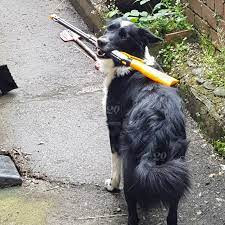
I have to say the actions of the dog after the body was found did make me wonder whether it had planted the evidence of the bramble, and refused to let anyone approach until it was sure the man was dead. But then if dogs were really that smart, owners would simply tell them to 'shit in this bag'.

Some may realise this is the same date as that of the killer cat story last time. It did make me wonder of if the editor of the Birmingham Daily Post had collected such tales (not tails) for a slow news week.

Sunday, 5 December 2021

That's not what I meant (Q)

I always enjoy a quiz, but I don't think I would have been as keen on the eighteenth-century descriptions.

Quaint is today used to refer to something out of the ordinary but visually acceptable. In the thirteenth century it was used to mean 'skilled' or 'elegant' or 'proud' and even 'fastidious'.

Queues are something the British are known to enjoy, except by the British, but when it first came to English from the French it meant 'tail'.


Quick is seen in Old English where it meant 'alive', unlike the modern 'rapid, speedy'.

Quilts are those covers which keep us warm but, when the term is first seen in the thirteenth century, it referred to something under the sleeper - in fact, what we would call a mattress.


Quite was first used in the fourteenth century to mean 'absolutely', as in "I'm quite alone". While that sense is still used today, it is also used to mean 'fairly, rather.'

Quiz is a knowledge test today, or perhaps as a verb can be used to mean 'cross-examine'. But as recently as the eighteenth century described 'an eccentric one' and even 'one who ridicules'.

Sunday, 21 February 2021

Bonfire Night 1878

November 5th 1878 and a fatal shooting is reported at the Gresley Arms Inn, the account appearing in the Lichfield Mercury on November 8th. William George Green, landlord of the Gresley Arms Inn, is playing host to a number of individuals while in the background a host of bangs are going off as the traditional fireworks are let off to remember the uncovering of the Gunpowder Plot.

During the evening Green slipped away to borrow a pistol from neighbour Henry Joseph Stych. Green informs Stych he is going to fire the pistol in the kitchen where his friends have gathered, thinking this would be thoroughly amusing jape. Green asks Stych to load the pistol as his knowledge of firearms is minimal. As he returned with the loaded pistol, Green stumbled and the gun went off, whereupon one Samuel Bates collapsed. Green later maintained the pistol contained nought but gunpowder, no shot had been loaded. This seemed unlikely as Bates, now lying on the floor, had blood coming from his head. Green sent Stych to find a doctor and the police superintendent, although their arrival was simply to pronounce the man dead and to summon a surgeon to carry out the postmortem. The inquest, arranged for the following day, was presumed to be a mere formality. Yet the surgeon discovered a glass marble embedded in the skull during the postmortem which was brought as evidence the following day at the Gresley Arms Inn before the coroner Mr Simpson.


Stych was the first to give evidence, telling how Green came to him at 8pm the previous day and explained how he saw the prank working. Together both men observed the gun being loaded with nothing but paper and powder and by 8:20pm Green and the loaded gun returned to the Gresley Arms with Stych coming along to enjoy the fun. However Stych entered first and, with his back to the events, did not see what happened. Contemporary reports stated how very nervous Stych was and the coroner had to ask him to speak up repeatedly. The jurors were allowed to ask questions of Stych in order to ascertain just how the marble had been loaded in the gun. George Cotton, who had been working with Bates and was lodging at the inn, said he heard the explosion and saw the blood but never noticed a gun – Cotton also added that Green had been very friendly and he could not see how he would have had a motive. Then fellow workmates Edward Plummer and James Ellson took to the witness stand and gave the same stories as Cotton. Mrs Stych also spoke, she Henry’s mother, also said she saw Green enter the inn and it seemed to her the gun had caught on an iron bar as he passed and thus the gun went off accidentally. She refused to confirm that marbles could be found around her home, this the coroner declared ‘not at all credible’. Green maintained he had brought the gun into the inn most carefully and as safely as could ever be expected. At no time did the gun leave his sight, nor did he load a marble or ever see any marble.


George William Homan, the surgeon performing the postmortem, reported how he found Bates lying on the kitchen floor, propped by pillows. He was found to be dead, and he observed a wound at his left temple just above the eyebrow, this large enough to insert a finger into the brain, he then showed the marble he extracted to the court and the cries of horror were testament to the unexpectedly large size of this marble. Witnesses said that Bates had been bending forward when the shot rang out. The witnesses acted out their roles and places for the coroner, to show how they observed Green returning to the kitchen preceded by Stych. Then someone pointed out the marble in question could not have been fired from the pistol as it was too large to fit into the powder chamber. Stych did admit he was using the gun earlier that day for target practice, but no marbles were involved. He was given ample opportunity to state he had unknowingly placed the marble in the gun but, with evidence pointing to the contrary, he never admitted doing such. Green apparently fired the gun accidentally, he admitting it went off while he was carrying it but denied he had pulled the trigger. The coroner was unsure how the marble had entered the skull but certainly nobody present could have targeted Bates and a verdict of accidental death was recorded.

Sunday, 14 February 2021

Friday the 13th

Friday 13th April 1832. The following week the local press reported the sad death of a groom, he in charge of three horses belonging to “a most worthy gentleman” passing through the city on his way to London. The youth was described as “a fine, handsome, and intelligent young man of the lower classes” – amazing how wonderful he was and yet they didn’t bother to find out his name – was obviously not sober before he arrived in Lichfield but was most inebriated by the time he left the city. As time passed his “drunkenness increased its despotic tyranny over him” – until 10 miles down the road he fell from his horse and to his death. He died from a fractured skull at 10am on the following morning, Saturday.