As last time, when researching I do sometimes come across a piece which is possibly not intended to be amusing, but I found it so and for that reason I shall share it. This comes from the Birmingham Daily Post dated 7th November 1894.
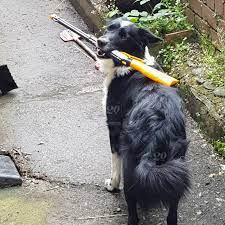
The Essex coroner held an inquest on Monday night on the body of Mr James Cornwell, of Castle Hedingham, who was found with a gunshot wound in his head, lying in a ditch in the neighbourhood, on Saturday. Mr Cornwell left his home on Friday night to go to a neighbouring village. He had with him his gun, and was accompanied by a collie dog. As he did not return in the evening a search was made for him, and on the following day his lifeless body was found in a ditch near Long Crofts. The left barrel of the gun had been discharged, and there was a bramble between the triggers. The face was shattered by a gunshot. The collie was found watching by the side of its master, and refused to allow the body to be touched until Mrs Cornwell arrived. The jury returned a verdict of "Accidental death",
I have to say the actions of the dog after the body was found did make me wonder whether it had planted the evidence of the bramble, and refused to let anyone approach until it was sure the man was dead. But then if dogs were really that smart, owners would simply tell them to 'shit in this bag'.
Some may realise this is the same date as that of the killer cat story last time. It did make me wonder of if the editor of the Birmingham Daily Post had collected such tales (not tails) for a slow news week.
Showing posts with label pet. Show all posts
Sunday, 13 March 2022
Sunday, 6 March 2022
Cats
Sometimes when researching I come across a piece which is possibly not intended to be amusing, but I found it so (possibly because of her surname) and for that reason I shall share it. This comes from the Birmingham Daily Post dated 7th November 1894.
Mr. Wynne E. Baxter held an enquiry in London, yesterday, respecting the death of Emma Kipper, aged fifty-eight, the wife of a carpenter. On the 10th of last month deceased crossed her room, when she trod on the tail of her cat, which turned round and bit her on the back of the leg. She said she felt the teeth go right to the bone. She became very ill, and was removed to the hospital, when it was found that there were wounds on the back of the left foot and a portion of the leg was gangrenous. The cause of death was infective spreading gangrene, the origin of which was possibly the bite of the cat. The jury returned a verdict of "Accidental death through the bite of a cat."
Sunday, 13 February 2022
Valentine's Day
For Valentine's Day, I thought I would take a look at the many terms of endearment found in English. Of course, I will look at these through the eyes of the etymologist. I've only used single words, phrases and most compound terms are ignored - and, most importantly, I've quite obviously stuck with those which may convey a slightly different meaning.
Babe is actually an earlier word than 'baby', itself the diminutive of 'babe'. The word is first seen as baban in the early thirteenth century, which almost certainly began as being imitative of baby talk (just as the word 'babble' is).
Honey is an old word, originates in Proto-Germanic hunang with the same meaning. The root is Proto-Indo-European, although it is not clear what that root is. One suggestion is kenekos meaning 'golden, yellow' or even 'brownish', all of which could describe the colour of honey. Such simplicity is common in early forms of language, for example many animal names are derived from their colour: bear 'brown' and hare 'grey'.
Sweetie is a diminutive of 'sweet', itself from Old English swete which, rather than describing a taste, referred to a person's disposition as 'pleasant'. Hence, what is seen as the modern use of 'sweet' is actually the original.
Love has not changed in meaning since its earliest known form of Proto-Indo-European leubh, used to mean 'care, desire, love'.
Sunshine is related to an Old English word sunscin which meant 'mirror'. It is worth noting how in the times when Old English was spoken, a mirror was a valuable item.
Dear is, like the word 'love', unchanged in all its meanings throughout its use.
Darling is a diminutive of 'dear' above.
Cupcake is not known as a compliment until the 1930s. It seems improbable that it could ever have been intended to refer to someone as 'sweet and desirable' - always assuming you like cake, or course.
Muffin is a word which is common to Western European languages, be they in the Latin group (French, Spanish, Italian, Portuguese) or the Germanic arm (English, German, Dutch, Danish, Norwegian, Swedish), for both refer to a soft cake or bread roll.
Buttercup is a word unrecorded before 1777. Earlier the flower was known by two names, either a goldcup or a butterflower. Clearly all three names refer to the colour and shape of the flower, although why and when it was first used as a term of endearment is unclear.
Sugar is sweet, which is why it was used as a term of endearment, but the etymology of 'sugar' is not quite so complimentary, for we find words in Arabic, Persian, Latin, and Sanskrit all meaning 'grit, gravel' coming from the Greek for 'pebble'. Sugar originated in India (hence the Sanskrit link) and spread around the old world courtesy of the empire of Alexander the Great, who marvelled at this 'honey without bees'.
Beautiful is from 'beauty', itself traceable back to Proto-Indo-European dw-en-elo meaning 'to do, perform, show favour, revere' depending upon context.
Peach is from the soft fruit, itself named as it was referred to as 'the Persian apple'.
Gorgeous comes from 'gorge', a French word used rather differently to the English version in staing 'something adorning the throat', and derived from the Proto-Indo-European gwora 'food, devour'.
Doll is a pet form of the name Dorothy, although today it is most often used to describe the child's toy (as it has since 1700). Earlier, from 1610, it was used to mean 'mistress, paramour', by 1640 the term was a synonym for 'slattern', and from 1778 is also seen as meaning 'silly woman'.
Tiger goes back to Old Persian tigra meaning 'sharp, pointed'. Fitting for the large cat, but perhaps not for a man.
Handsome is a compound, where the two words first united in the late 14th century to describe something as 'appropriate', and not seen in the modern sense until 1580.
Stud can be traced to Proto-Indo-European sta when it meant 'to stand, make firm', which should be seen as a permanent settlement where horses were bred.
Casanova clearly comes from the man renowned for his promiscuity, the 19th century Giacomo Girolamo Casanova. To understand this more, perhaps we should Anglicise the rogue's name - in which case we would be referring to Jacob Jerome Newhouse. Try describing that ladies man as a 'Newhouse' and see where it gets you.
Dreamboat comes from a song released in 1936 entitled When My Dream Boat Comes Home, although some sources credit it to the book entitled Dream Boat, published in 1929.
Sexy is clearly derived from 'sex, the latter coming from Latin sexus 'male or female'. Earlier roots are unclear, although there is some thought of it being dervied from the same root as 'section' and thus meaning 'divide'.
Munchkin is first seen in L. Frank Baum's The Wonderful Wizard of Oz published in 1900. The author never explained how he came up with the word.
Precious is related to 'price', itself from Proto-Indo-European pret-yo meaning 'to sell'.
Poppet is an early form of 'puppet', and became a term of endearment in the later 18th century, about the same time as it came to be used as an expression of contempt.
Hen, a slang term for a woman initially but one which also came to be used as a term of fondness, comes from a root which meant 'to sing'. Now I have often heard hens clucking, and would never refer to it as singing - although the 'hen' here is used to refer to the female of all birds.
Pet clearly comes from the use of the word as a favourite domesticated animal, the verb 'to pet' derived from that. But the word isn't seen until the late 15th century, prior to that it has the same origin as 'petty', from the French petit 'small'.
Mate has all manner of meanings throughout history - friends as much as much as mating - and all derived from ga-matjon which meant 'one having food together'.
Duck, as a term of endearment, comes from around 1580, when it would have referred to a person who walked with a waddle - as pregnant women are apt to with their balance affected by the excess weight carried. The word for the bird describes its tendency to dip below the water.
Babe is actually an earlier word than 'baby', itself the diminutive of 'babe'. The word is first seen as baban in the early thirteenth century, which almost certainly began as being imitative of baby talk (just as the word 'babble' is).
Honey is an old word, originates in Proto-Germanic hunang with the same meaning. The root is Proto-Indo-European, although it is not clear what that root is. One suggestion is kenekos meaning 'golden, yellow' or even 'brownish', all of which could describe the colour of honey. Such simplicity is common in early forms of language, for example many animal names are derived from their colour: bear 'brown' and hare 'grey'.
Sweetie is a diminutive of 'sweet', itself from Old English swete which, rather than describing a taste, referred to a person's disposition as 'pleasant'. Hence, what is seen as the modern use of 'sweet' is actually the original.
Love has not changed in meaning since its earliest known form of Proto-Indo-European leubh, used to mean 'care, desire, love'.
Sunshine is related to an Old English word sunscin which meant 'mirror'. It is worth noting how in the times when Old English was spoken, a mirror was a valuable item.
Dear is, like the word 'love', unchanged in all its meanings throughout its use.
Darling is a diminutive of 'dear' above.
Cupcake is not known as a compliment until the 1930s. It seems improbable that it could ever have been intended to refer to someone as 'sweet and desirable' - always assuming you like cake, or course.
Muffin is a word which is common to Western European languages, be they in the Latin group (French, Spanish, Italian, Portuguese) or the Germanic arm (English, German, Dutch, Danish, Norwegian, Swedish), for both refer to a soft cake or bread roll.
Buttercup is a word unrecorded before 1777. Earlier the flower was known by two names, either a goldcup or a butterflower. Clearly all three names refer to the colour and shape of the flower, although why and when it was first used as a term of endearment is unclear.
Sugar is sweet, which is why it was used as a term of endearment, but the etymology of 'sugar' is not quite so complimentary, for we find words in Arabic, Persian, Latin, and Sanskrit all meaning 'grit, gravel' coming from the Greek for 'pebble'. Sugar originated in India (hence the Sanskrit link) and spread around the old world courtesy of the empire of Alexander the Great, who marvelled at this 'honey without bees'.
Beautiful is from 'beauty', itself traceable back to Proto-Indo-European dw-en-elo meaning 'to do, perform, show favour, revere' depending upon context.
Peach is from the soft fruit, itself named as it was referred to as 'the Persian apple'.
Gorgeous comes from 'gorge', a French word used rather differently to the English version in staing 'something adorning the throat', and derived from the Proto-Indo-European gwora 'food, devour'.
Doll is a pet form of the name Dorothy, although today it is most often used to describe the child's toy (as it has since 1700). Earlier, from 1610, it was used to mean 'mistress, paramour', by 1640 the term was a synonym for 'slattern', and from 1778 is also seen as meaning 'silly woman'.
Tiger goes back to Old Persian tigra meaning 'sharp, pointed'. Fitting for the large cat, but perhaps not for a man.
Handsome is a compound, where the two words first united in the late 14th century to describe something as 'appropriate', and not seen in the modern sense until 1580.
Stud can be traced to Proto-Indo-European sta when it meant 'to stand, make firm', which should be seen as a permanent settlement where horses were bred.
Casanova clearly comes from the man renowned for his promiscuity, the 19th century Giacomo Girolamo Casanova. To understand this more, perhaps we should Anglicise the rogue's name - in which case we would be referring to Jacob Jerome Newhouse. Try describing that ladies man as a 'Newhouse' and see where it gets you.
Dreamboat comes from a song released in 1936 entitled When My Dream Boat Comes Home, although some sources credit it to the book entitled Dream Boat, published in 1929.
Sexy is clearly derived from 'sex, the latter coming from Latin sexus 'male or female'. Earlier roots are unclear, although there is some thought of it being dervied from the same root as 'section' and thus meaning 'divide'.
Munchkin is first seen in L. Frank Baum's The Wonderful Wizard of Oz published in 1900. The author never explained how he came up with the word.
Precious is related to 'price', itself from Proto-Indo-European pret-yo meaning 'to sell'.
Poppet is an early form of 'puppet', and became a term of endearment in the later 18th century, about the same time as it came to be used as an expression of contempt.
Hen, a slang term for a woman initially but one which also came to be used as a term of fondness, comes from a root which meant 'to sing'. Now I have often heard hens clucking, and would never refer to it as singing - although the 'hen' here is used to refer to the female of all birds.
Pet clearly comes from the use of the word as a favourite domesticated animal, the verb 'to pet' derived from that. But the word isn't seen until the late 15th century, prior to that it has the same origin as 'petty', from the French petit 'small'.
Mate has all manner of meanings throughout history - friends as much as much as mating - and all derived from ga-matjon which meant 'one having food together'.
Duck, as a term of endearment, comes from around 1580, when it would have referred to a person who walked with a waddle - as pregnant women are apt to with their balance affected by the excess weight carried. The word for the bird describes its tendency to dip below the water.
Sunday, 6 August 2017
Dogs
Never been a dog person myself, that doesn't mean I'm a cat person either. I'm not against animals, just never could relate to the idea of a pet. Anthropomorphising creatures never amused me as a child either - probably the reason I loathed Disney. Anyway I digress, back to dogs.
On a short break last week I overheard a conversation between a person with a dog and another who asked what breed it was, the answer given is it was a cross between a Shih Tzu and a Poodle - this apparently gives a Shih-poo. Now thoroughly irked by this awful creation - wouldn't Tzu-dle have been a better idea? - I thought I'd look at where other dog breeds originated. Dog people will probably enjoy this, too.
Afghan - a breed of hunting dog named in 1895, it is taken from the name of the country. I definedAfghanistan in an earlier post.
Airedale - named after a Yorkshire valley in which theRiver Aire flows, this discussed in an earlier post.
Alsatian - adopted as the name for the German Shepherd in 1917, well there was a war on, you know. The name comes from Alsace, itself giving a name to an undesirable area of London in the 1690s. Alsace was a region between Frrance and Germany, the place name from Old High German Ali-sazzo meaning 'inhabitant of the other (bank of the Rhine). Note in the 1690s 'Alsatian' was a term referring to 'a London criminal'.
Basenji - bred around the northeastern Congo and known in Swahili as mbwa shenzi this name means 'wild dog'.
Basset - a diminutive form of Old French bas meaning 'low'.
Beagle - Snoopy will be delighted to learn this comes from the French becguele 'noisy person' and derived from bayer 'open wide' and guele 'mouth'.
Bedlington - a weird looking thing named after the town of Bedlington in Northumberland, itself from Old English and referring to 'the farmstead associated with a man called Bedla or Betla'.
Bloodhound - of obvious origins considering its famous tracking abilities, what may be of more interest is the origin of the constituent parts in 'to swell' and 'dog' respectively.
Border terrier - known as such because of its association with the Border Hunt in Northumberland.
Borzoi - from the Russian borzoy meaning 'swift, quick'.
Boston - originally a Lincolnshire place name but better known as the capital of the state ofMassachussetts and discussed in that earlier blog post.
Boxer - a dog known for its pugnaciousness, the word 'boxer' is the agent noun of 'box', itself taken to mean 'blow'.
Bulldog - unknown as to whether this was a reference to its bull-like stance or it may have been used to bait bulls. Now 'bull' itself comes from Proto-Indo-European bhel which is exactly the same root as found for 'blood' (above) in 'to swell'.
Cairn - named as it was bred specifically to hunt down quarry between the cairns of the Scottish Highlands. Incidentally 'cairn' shares a root with 'horn' in meaning 'the highest part of the body'.
Chihuahua - named after the state of Chihuahua in Mexico, a name often disputed but the majority tend to favour a Nahuatl origin meaning 'the place where the water of the rivers meet', a rather long definition when 'confluence' will suffice.
Clumber - named from Clumber Park in Nottinghamshire, which seems to be a combination of an old British river name Clun (never understood) and bre 'hill'.
Clydesdale - another from a place name, or rather a river name and discussed under anearlier post .
Chow - known in China as songshi quan or 'puffy lion dog', which will undoubtedly please owners of this, one of the ancient breeds, more than the meaning of the name chow 'food'.
Cocker spaniel - comes from its original use to hunt woodcock.
Collie - shares an origin with the sheep term colley 'sheep with black face and legs'. Middle English referred to this as a colfox 'coal fox', while colley is a Somerset dialect term for the blackbird.
Corgi - is from the Welsh 'dwarf' and ci 'dog'.
Dachschund - is German for 'badger dog'.
Dalmatian - said to be named from the Croatian area of Dalmatia, itself from Proto-Indo-European dhal 'to bloom' and used to refer to the young animals seen on the mountain pastures.
Dandy dinmont - named after a character in Sir Walter Scott's novel Guy Mannering, one James Davidson.
Deerhound - of obvious meaning but of interest is the origin of 'deer' in Proto-Indo-European dheu 'cloud, breath' and ultimately simply referring to something that was alive but not human.
Dingo - is from the language Dharruk, this spoken by those found resident in the area around modern Sydney when Europeans first arrived, where din-go simply means 'tame dog'.
Dobermann - German for 'fox terrier'.
Elkhound - another of obvious derivation, with the name 'elk' derived from the root el 'red, brown'.
Foxhound - another of obvious origin, the word 'fox' derived from Proto-Indo-European puk 'tail'.
Fox terrier - (see above)
Golden retriever - another obvious name, although we could add 'golden' comes from a root meaning 'shine' and 'retriever', for its ability to return game undamaged, from a root meaning 'to turn'.
Great dane - comes from Denmark, where the people of the mark 'border' were the Danes, themselves named for the den or 'low ground'. Ironic considering the size of the dog.
Greyhound - as many will realise, a greyhound is not grey (well very rarely), and colour is not the origin. Here the origin is grig 'bitch', it is common to find a creature named for the female.
Griffon - an alternative spelling of 'griffin', likely used to mean 'hybrid' as the mythological griffin had features of the eagle and the lion.
Harrier - uncertain but this hunting dog could be from the Middle French errier 'wanderer' or from the verb 'harry' (which is the origin of the bird known by the same name) and thus derived from a root meaning 'war, army'.
Husky - was known as the hoskey until the early 19th century, a word also used to mean 'eskimo', itself from the Proto-Algonquian language where ask 'raw' and imo 'eat' described their diet.
Irish setter - clearly named from its associated with Ireland, a place name meaning 'the land of the Irish' and the people taking their name from the root peie 'to be fat' - not a reference to their waistline but the productivity of the land. The word 'setter' is the agent noun of 'set', a reference to being 'set' on the game when hunting.
Kelpie - little is understood of this name but it may come from Gaelic colpach 'heifer, steer, colt', possibly as it was used much as a sheepdog would be.
King Charles spaniel - obviously named after the monarch, his Christian name meaning 'man, husband' while the term 'spaniel' comes from its assocation with Spain, a country thought to speak of itself as 'the land of the rabbits'.
Labrador - named after the Canadian province, itself from the Portuguese explorer Jaoa Fernandes Lavrador, whose family name was Fernandes, the term lavrador meaning 'farmer' or 'plougher'.
Maltese - clearly named from the island of Malta, itself possibly from the Greek name for the place Melita 'honey-sweet' for the islands native bees produced a unique honey.
Mastiff - from the Old French mastin 'great cur', itself from Latin mansuetus 'tae, gentle' and probably showing this was bred to be a house dog.
Mongrel - from the Old English gemong 'mingling' and ultimately Proto-Indo-European mag 'to knead, fashion, fit'. Hence the original idea of a mongrel was to interbreed other creatures to produce a new breed, exactly the opposite of the negative ideas of the modern era.
Otterhound - well no need to explain anything but the origin of 'otter', this began as Proto-Indo-European udros 'water creature'.
Pekinese - named after the city, now known as Beijing, and itself simply meaning 'north capital'.
Pointer - from its posture when used in hunting.
Pomeranian - named after the former province of Prussia, inhabited by a Slavic tribe who were known in Polish as po morze 'by the sea'.
Pug - named for its pug nose appearance, the word was earlier seen in a negative light and is derived from 'puck' 'devil, evil spirit, sprite'.
Rottweiler - named after the town of Rottweil in Germany, itself has the suffix for 'village' and the first element likely a personal name.
Saluki - two Sumerian words combine here to mean 'pluge earth', although what that ever denotes is a complete mystery.
Schnauzer - the literal translation is 'snout' but colloquially used to mean 'moustache'.
Sealyham - bred at and named after Sealyham House in Permbokeshire, this place name comes from the River Sealy, a name of unknown origin.
Sheepdog - no need for any comment here at all.
Skye terrier - takes its name from the Scottish island of Skye, this thought to be an early Celtic word skitis meaning 'winged', a resaonable description of the peninsulas radiating from the mountainous centre.
Staffordshire - taken from the name of the county and ultimately the county town, I looked at this a couple of years ago with looking atEnglish Place Names and my books.
St Bernard - named after two hospices offering aid to travellers in the Alps, they coming from the name of the Great St Bernard Pass and Little St Bernard Pass, itself named from a saint whose name means 'bold as a bear'.
Terrier - comes from the Old French chien terrier 'earth dog', derived from the Latin terra 'earth' and ultimately from the Proto-Indo-European ters 'to dry'.
Whippet - a diminutive of 'whip' as in 'to move quickly'. The term 'whip' comes from Proto-Indo-European weip meaning 'to turn, vacillate'.
I wonder if any of these derivations will give any dog owners ideas as to potential names for their pet? Oddly the subject of names for a dog came up in a recent episode of my favourite podcast, episode number 175 ofNo Such Thing as a Fish , entitled No Such Thing As A Rice Krispie With Feelings. Enjoy!
On a short break last week I overheard a conversation between a person with a dog and another who asked what breed it was, the answer given is it was a cross between a Shih Tzu and a Poodle - this apparently gives a Shih-poo. Now thoroughly irked by this awful creation - wouldn't Tzu-dle have been a better idea? - I thought I'd look at where other dog breeds originated. Dog people will probably enjoy this, too.
Afghan - a breed of hunting dog named in 1895, it is taken from the name of the country. I defined
Airedale - named after a Yorkshire valley in which the
Alsatian - adopted as the name for the German Shepherd in 1917, well there was a war on, you know. The name comes from Alsace, itself giving a name to an undesirable area of London in the 1690s. Alsace was a region between Frrance and Germany, the place name from Old High German Ali-sazzo meaning 'inhabitant of the other (bank of the Rhine). Note in the 1690s 'Alsatian' was a term referring to 'a London criminal'.
Basenji - bred around the northeastern Congo and known in Swahili as mbwa shenzi this name means 'wild dog'.
Basset - a diminutive form of Old French bas meaning 'low'.
Beagle - Snoopy will be delighted to learn this comes from the French becguele 'noisy person' and derived from bayer 'open wide' and guele 'mouth'.
Bedlington - a weird looking thing named after the town of Bedlington in Northumberland, itself from Old English and referring to 'the farmstead associated with a man called Bedla or Betla'.
Bloodhound - of obvious origins considering its famous tracking abilities, what may be of more interest is the origin of the constituent parts in 'to swell' and 'dog' respectively.
Border terrier - known as such because of its association with the Border Hunt in Northumberland.
Borzoi - from the Russian borzoy meaning 'swift, quick'.
Boston - originally a Lincolnshire place name but better known as the capital of the state of
Boxer - a dog known for its pugnaciousness, the word 'boxer' is the agent noun of 'box', itself taken to mean 'blow'.
Bulldog - unknown as to whether this was a reference to its bull-like stance or it may have been used to bait bulls. Now 'bull' itself comes from Proto-Indo-European bhel which is exactly the same root as found for 'blood' (above) in 'to swell'.
Cairn - named as it was bred specifically to hunt down quarry between the cairns of the Scottish Highlands. Incidentally 'cairn' shares a root with 'horn' in meaning 'the highest part of the body'.
Chihuahua - named after the state of Chihuahua in Mexico, a name often disputed but the majority tend to favour a Nahuatl origin meaning 'the place where the water of the rivers meet', a rather long definition when 'confluence' will suffice.
Clumber - named from Clumber Park in Nottinghamshire, which seems to be a combination of an old British river name Clun (never understood) and bre 'hill'.
Clydesdale - another from a place name, or rather a river name and discussed under an
Chow - known in China as songshi quan or 'puffy lion dog', which will undoubtedly please owners of this, one of the ancient breeds, more than the meaning of the name chow 'food'.
Cocker spaniel - comes from its original use to hunt woodcock.
Collie - shares an origin with the sheep term colley 'sheep with black face and legs'. Middle English referred to this as a colfox 'coal fox', while colley is a Somerset dialect term for the blackbird.
Corgi - is from the Welsh
Dachschund - is German for 'badger dog'.
Dalmatian - said to be named from the Croatian area of Dalmatia, itself from Proto-Indo-European dhal 'to bloom' and used to refer to the young animals seen on the mountain pastures.
Dandy dinmont - named after a character in Sir Walter Scott's novel Guy Mannering, one James Davidson.
Deerhound - of obvious meaning but of interest is the origin of 'deer' in Proto-Indo-European dheu 'cloud, breath' and ultimately simply referring to something that was alive but not human.
Dingo - is from the language Dharruk, this spoken by those found resident in the area around modern Sydney when Europeans first arrived, where din-go simply means 'tame dog'.
Dobermann - German for 'fox terrier'.
Elkhound - another of obvious derivation, with the name 'elk' derived from the root el 'red, brown'.
Foxhound - another of obvious origin, the word 'fox' derived from Proto-Indo-European puk 'tail'.
Fox terrier - (see above)
Golden retriever - another obvious name, although we could add 'golden' comes from a root meaning 'shine' and 'retriever', for its ability to return game undamaged, from a root meaning 'to turn'.
Great dane - comes from Denmark, where the people of the mark 'border' were the Danes, themselves named for the den or 'low ground'. Ironic considering the size of the dog.
Greyhound - as many will realise, a greyhound is not grey (well very rarely), and colour is not the origin. Here the origin is grig 'bitch', it is common to find a creature named for the female.
Griffon - an alternative spelling of 'griffin', likely used to mean 'hybrid' as the mythological griffin had features of the eagle and the lion.
Harrier - uncertain but this hunting dog could be from the Middle French errier 'wanderer' or from the verb 'harry' (which is the origin of the bird known by the same name) and thus derived from a root meaning 'war, army'.
Husky - was known as the hoskey until the early 19th century, a word also used to mean 'eskimo', itself from the Proto-Algonquian language where ask 'raw' and imo 'eat' described their diet.
Irish setter - clearly named from its associated with Ireland, a place name meaning 'the land of the Irish' and the people taking their name from the root peie 'to be fat' - not a reference to their waistline but the productivity of the land. The word 'setter' is the agent noun of 'set', a reference to being 'set' on the game when hunting.
Kelpie - little is understood of this name but it may come from Gaelic colpach 'heifer, steer, colt', possibly as it was used much as a sheepdog would be.
King Charles spaniel - obviously named after the monarch, his Christian name meaning 'man, husband' while the term 'spaniel' comes from its assocation with Spain, a country thought to speak of itself as 'the land of the rabbits'.
Labrador - named after the Canadian province, itself from the Portuguese explorer Jaoa Fernandes Lavrador, whose family name was Fernandes, the term lavrador meaning 'farmer' or 'plougher'.
Maltese - clearly named from the island of Malta, itself possibly from the Greek name for the place Melita 'honey-sweet' for the islands native bees produced a unique honey.
Mastiff - from the Old French mastin 'great cur', itself from Latin mansuetus 'tae, gentle' and probably showing this was bred to be a house dog.
Mongrel - from the Old English gemong 'mingling' and ultimately Proto-Indo-European mag 'to knead, fashion, fit'. Hence the original idea of a mongrel was to interbreed other creatures to produce a new breed, exactly the opposite of the negative ideas of the modern era.
Otterhound - well no need to explain anything but the origin of 'otter', this began as Proto-Indo-European udros 'water creature'.
Pekinese - named after the city, now known as Beijing, and itself simply meaning 'north capital'.
Pointer - from its posture when used in hunting.
Pomeranian - named after the former province of Prussia, inhabited by a Slavic tribe who were known in Polish as po morze 'by the sea'.
Pug - named for its pug nose appearance, the word was earlier seen in a negative light and is derived from 'puck' 'devil, evil spirit, sprite'.
Rottweiler - named after the town of Rottweil in Germany, itself has the suffix for 'village' and the first element likely a personal name.
Saluki - two Sumerian words combine here to mean 'pluge earth', although what that ever denotes is a complete mystery.
Schnauzer - the literal translation is 'snout' but colloquially used to mean 'moustache'.
Sealyham - bred at and named after Sealyham House in Permbokeshire, this place name comes from the River Sealy, a name of unknown origin.
Sheepdog - no need for any comment here at all.
Skye terrier - takes its name from the Scottish island of Skye, this thought to be an early Celtic word skitis meaning 'winged', a resaonable description of the peninsulas radiating from the mountainous centre.
Staffordshire - taken from the name of the county and ultimately the county town, I looked at this a couple of years ago with looking at
St Bernard - named after two hospices offering aid to travellers in the Alps, they coming from the name of the Great St Bernard Pass and Little St Bernard Pass, itself named from a saint whose name means 'bold as a bear'.
Terrier - comes from the Old French chien terrier 'earth dog', derived from the Latin terra 'earth' and ultimately from the Proto-Indo-European ters 'to dry'.
Whippet - a diminutive of 'whip' as in 'to move quickly'. The term 'whip' comes from Proto-Indo-European weip meaning 'to turn, vacillate'.
I wonder if any of these derivations will give any dog owners ideas as to potential names for their pet? Oddly the subject of names for a dog came up in a recent episode of my favourite podcast, episode number 175 of
Subscribe to:
Posts (Atom)