Showing posts with label well. Show all posts

Sunday, 16 January 2022

That was not what I meant. (WXYZ)

I'm not commenting on the fourth word in today's list, I'm going for a walk instead.

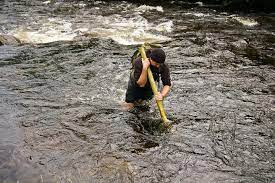
Wade is today specifically 'to walk through water', originally it just meant 'to progress'.

Wafts are only carried through the air, although in the original sense it described ships moving in convoy.

Waif or stray is an abandoned child or animal, but in the fourteenth century it was a piece of property without an owner.

Walk needs no explanation, except in the thirteenth century the word meant 'roll, toss'.

Watch, as in 'to be alert', was originally simply used to mean someone was awake.

Well as in 'healthy', began in English as meaning 'happy, fortunate'.

Wince is to 'shrink from pain', but in the thirteenth century meant 'to kick restlessly' and was used often when referring to horses.

With is 'accompanying' today, but in Old English it had entirely the opposite meaning of 'against'.

Wizard is a magician today, but if we look at it as 'wise-ard' we can see the original idea of a wise man.


Worry of 'fret' was used as recently as 1606 to mean 'strangle'.

Wrong didn't mean 'incorrect' until the fifteenth century, prior to that it was 'crooked, bent'.

Zoology refers to the study of animals, but originally referred to the study of animals in the pursuit of finding cures for human ailments.

Sunday, 25 August 2019

Niger Place Names Explained

Having blogged samples of my books on English place names and also examined the etymologies of the nations of the world and their respective capitals I thought it time I cast my net a little wider. As English place names share some links to other tongues it would be interesting to see if any of the elements contributing to our place names could be found elsewhere. Continuing an alphabetical tour of the world and a look at the largest of Niger's cities.


Niamey refers to where the local tribe drew water 'to the left of the tree' from the river which gave Niger its name, the river Niger coming from the Tamashek language where gher n-gheren means 'river among rivers'.


Birni-N'Konni is derived from the Hausa language and refers to 'the walled town of Konni'.


Dogondoutchi, usually reffered to as simply Doutchi, is derived from a local phrase meaning 'high hill'.


Doro is a Beri-Beri name simply meaning 'fishing port'.


Tchintabaraden translates as 'the valley of the young girls', named because young women and girls were once forced to head to a large well on a daily basis for water. Since running water has been installed, this is no longer necessary.


Mayahi or Mayaki, is from the Hausa people's name for their ruler.


Note the spellings of the places are English as the piece is written in English.

Tuesday, 21 May 2019

Mauritania Place Names Explained

Having blogged samples of my books on English place names and also examined the etymologies of the nations of the world and their respective capitals I thought it time I cast my net a little wider. As English place names share some links to other tongues it would be interesting to see if any of the elements contributing to our place names could be found elsewhere. Continuing an alphabetical tour of the world and a look at the largest Mauritania settlements.


Nouakchott is the administrative and economic centre of Mauritania, its name is a corrupted form of the original Berber Nawasksut or 'place of the winds'.


Akjoujt has a long history of mining, archaeologists dating the earliest workings here as at least three thousand years old. The name does not reflect the history of metals but does mean 'wells'.


Hodh Ech Chargui is an Arabic name and refers to its location as the 'eastern basin region'.


Senegal River has three common explanations, most often said to be the name of a Wolof chieftain, or alternatively from the Wolof phrase sunu gaal or 'our canoe'. Despite these being the most common explanations, neither stand up to scrutiny. Most agree it is more likely to come from a Portuguese term, Azenegue referring to the Berber Zenaga people residing here when they arrived.


Adrar is a region and plateau both named from the Berber word for 'mountain'.


Hodh El Gharbi is named from the Arabic and means 'western basin region'.


Note the spellings of the places are English as the piece is written in English.

Sunday, 27 January 2019

Lebanon Place Names Explained

Having blogged samples of my books on English place names and also examined the etymologies of the nations of the world and their respective capitals I thought it time I cast my net a little wider. As English place names share some links to other tongues it would be interesting to see if any of the elements contributing to our place names could be found elsewhere. Continuing an alphabetical tour of the world and a look at the largest Lebanese cities.


Beirut is the capital, an Anglicised version of the Arabic Bayrut. This is ultimately from the Phoenician place name Berot or Birut, both seen in the Canaanite or Phoenician be'rot which, some 3,500 years ago, describes this place as 'the wells'.


Tripoli can also be traced back to the Phoenician age, during which time it has had several names. This name is derived from the Greek and means 'the three cities'. The Arabic name is al-fayha 'the scent or smell' and a reference to the vast orange orchards once found here.


Sidon comes from the Phoenician Sidun 'fishing town'.


Tyre refers to its location on a rocky formation and means simply 'rock'.


Byblos is difficult to trace because of the variety of records coming from speakers from several languages. It is most likely a name meaning 'God's well', where the name refers to God's place rather than a source of water.


Aley is from Aramaic and means 'high place', it does indeed stand at least six hundred metres above sea level.


Nabatieh is another from Phoenician, this meaning 'the appearance' and a reference to how it would have been easily recognised from the sea owing to its many grottoes.


Baalbek was known as Helioupolis or 'sun city' to the Greeks. Its present name refers to 'Ba'al, Lord of the Beka'.


Zahle is a Syriac word meaning 'moving places' and points to the continuous danger of landslides in this area.


Zgharta has been explained as coming from the Aramaic zaghar or 'fortress'.


Ehden is a region named from the Aramaic for 'the mountain's base and slope'.


Batroun is from the Arabic al-Batroun and the Phoenician word bater 'to cut'. A reference to the sea wall which created the harbour here.


Note the spellings of the places are English as the piece is written in English.